The Internet Trap
- Amie Martinez

- Feb 1, 2021
- 3 min read
MC7019: Week 3 Blog
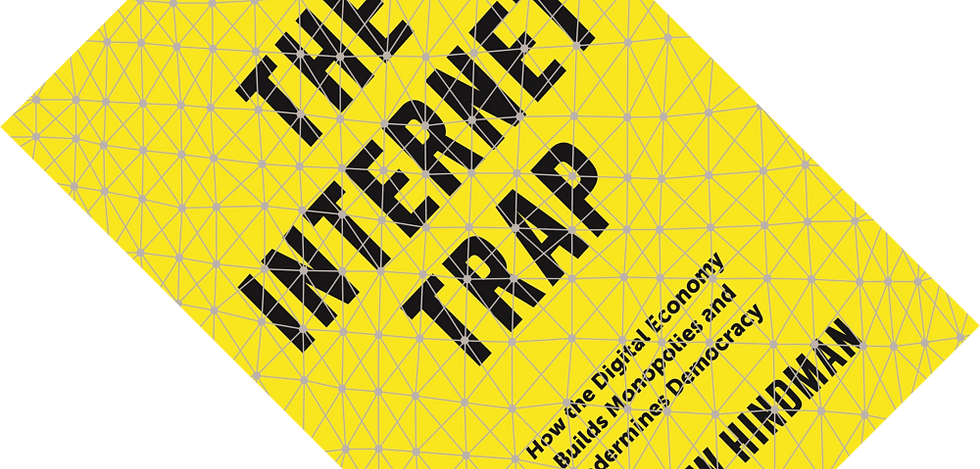
Facebook and Google scare me. No, not because of the overwhelming amount of information we now have access to or because of the inevitable cringey posts my mother always does for my birthday (although those are pretty scary). I'm scared of Facebook and Google's business models. We all know that they receive endless streams of personal data about us on a daily basis, but sometimes we don't know what they actually do with that personal data. We blindly trust these companies by surrenduring personal information they find commercially valuable. With that comes great power and great responsibility, but no one holds digital giants like Facebook or Google accountable for that responsibility. I'm not scared enough to not use the platforms because, let's be honest, it would be extremely difficult to function in life (or graduate school for that matter) without being able to Google something. Because of our reliance on companies like Facebook and Google, we need to understand more fully what they do to keep our attention grabbed, how they actually got to that point and what else they impact in our democracy.
Matthew Hindman's "The Internet Trap" shows us why there is no such thing as a free audience online and how the largest players like Facebook and Google still come out on top. He equates Google's billion-dollar server farms to industrial mills from the early 1900s - something I had never really thought about before. The grand investment and research done by these companies aim to create digital environments we "stick" to - a place where we always want to go and stay. This "attention economy," Hindman points out, refers to how money and attention are exchanged for one another online. The websites and content we mostly receive online are free because we are the product to media companies. Our attention is so valuable that advertisers pay big bucks to get not only their consumer products but also their ideas, policies, political beliefs and more into our news feeds. Those who can afford the expenditures climb the ladder and make it even harder for smaller players to actually enter the market on the internet and keep our attention.
One of those smaller players is local media. The tech titans not only affect us as individual users, but also undermine local journalism. Hindman indicates that news consumption overall is declining and local news outlets are losing out to national news online. His study found that "less than one in five news page views goes to a local news source." This evidence contradicts the idea that the internet would amplify local news voices and add new, diverse voices to the media landscape. Furthermore, local news media struggle with stickiness to keep their online readership robust and boost profit. But how can our local news outlets even begin to compete with large digital giants for our attention when we as users aren't primarily interested in getting news online?
Australia is currently battling Facebook and Google to make them pay for news content produced by journalists and media companies. The platforms distribute news content to users all around the world, but the advertising revenue goes to the digital giants and not the media companies who produced the content. Journalists want a share of the profit they helped to generate because the newspapers and TV stations they work for are struggling to stay afloat. Advertising is the lifeline of media companies, and if there isn't a consistent flow of advertisers, newspapers and TV stations have no choice but to produce less content, lay off employees or shut down. These consequences, of course, would be detrimental to us as a democracy.
Hindman's book is an excellent resource for understanding how digital economies of scale "skew the game toward the largest players." The internet is not as decentralized as we think it is. Companies like Facebook and Google can and will continue to exploit our personal data for their benefit without repercussions and undermine local journalism unless regulation is in place. To be frank, the world depends on it.


Comments