Instagram Has Changed How We View the World
- Amie Martinez

- Mar 22, 2021
- 4 min read
MC7019: Week 10 Blog

Of all the popular social media apps today, Instagram is definitely my favorite. I love scrolling through my feed to see nice pictures, direct messaging funny memes and reposted TikToks I find in the Explore tab to my friends and watching/creating cute, interactive Stories. I've been a regular user of Instagram for nearly a decade - since Sept. 29, 2012, to be exact. I was a freshman in high school when I first joined, when times were simpler with filter like Rise, X-Pro II, Lo-Fi (my favorite) and Nashville being showcased on the super blocky and vintage-inspired platform. It's been fascinating to see how much Instagram has become a nearly inescapable part of everyday life not just for me but for the other billion users worldwide. Scholars Tama Leaver, Tim Highfield and Crystal Abidin examine how the platform has become so rooted into our lives in their 2020 book "Instagram: Visual Social Media Cultures." This book is an essential read for anyone working in the public relations, media and mass communication field, and I'm really glad we got to read it for this class.
Instagram's success has come from its successful integration and balancing of photography and socialization. When Facebook bought it for $1 billion in 2012 (only a year and a half after it was created), the new advertising revenue and endless streams of data information started rolling in big time. Constant updates and platform features including the new logo, algorithmic timeline, Stories, IGTV and now Reels have overtime made the platform "stickier" for its younger audience and challenged its competitors Snapchat, YouTube and TikTok. New changes like these are always faced with backlash from users who subsequently go on Twitter to complain about the updates. But then after a month or so, everyone becomes so used to the new features that they don't even remember Instagram without them.
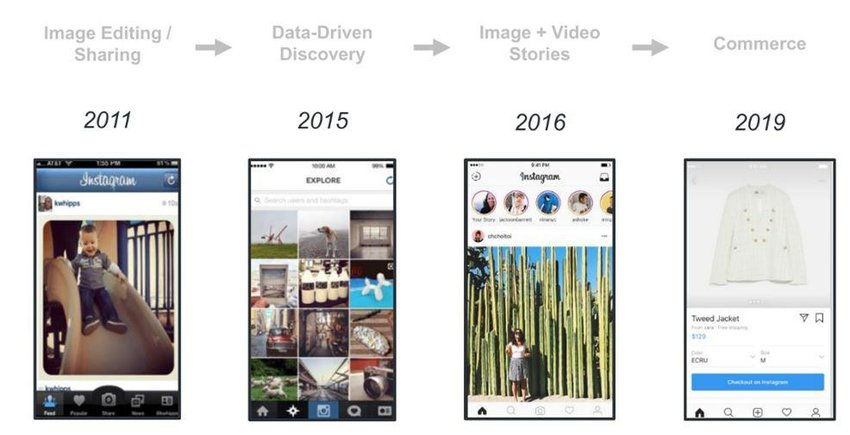
Beyond discussing the physical changes in the platform, the authors provide great insight into the changes visual aesthetics and influencer economies have made on the culture of the platform and in real life. Social media influencers and #sponsored posts are everywhere on Instagram, and businesses of all kinds have reshaped their environment, design and services to be more "Insta-worthy" to customers. Commerce and online shopping are key to the platform now - much more than simply posting on your feed like it was back in 2010. Additionally, the way we're expected to present ourselves, our businesses, our brands and our lived experiences on Instagram using highly edited, "perfect" pictures have greatly influenced how we view the world around us.
Take, for example, traveling. It seems nowadays that it is more important to show off the pictures of you having a great time rather than enjoying the experience of traveling itself. This idea is nothing new, as seen in the 1962 book "The Image" by Daniel Boorstin which I read for another class last semester. Boorstin argued that the invention of cameras and photography led people to adore not the place they capture but rather the picture they took of that place instead. If someone travels to the Grand Canyon, it's becoming increasingly not about "Wow, look how beautiful the Grand Canyon is!" but more about, "Wow, look how beautiful my picture of the Grand Canyon is!" Boorstin further says that when we travel, we see if the images of those places match with what we see on TV, read in a magazine or see on social media today. We don't "test the image by the reality, but rather test reality by the image." In short, our expectations are too high because of the highly edited and staged images we're being feed. I believe this is significantly heightened today because of the "perfect" travel pictures we constantly see on Instagram and other platforms. I also believe that when we're conditioned to think that Paris, for example, is some kind of beautiful and romantic city, we intentionally overlook the overcrowded, cigarette-odored streets that we see, too - especially when we talk or post about our trip there. Our expectations mess with how we perceive reality.
Many of us become distracted in our travel experiences and beyond (e.g., at concerts, weddings, museums and social gatherings) because we get so caught up in how we want the experience to look on our social media. I've already told myself that I refuse to post endless Instagram and Snapchat stories of my honeymoon because I want to enjoy our time rather than feel this weird, inherent pressure to share pictures of the resort and the view on social media. Plus, numerous studies have shown that taking photos of events make them less likely to remember. These findings beg the question: How many things in our lives do we actually experience fully? Now I'm not saying that we shouldn't take pictures wherever we go because it's obviously really important to capture those memories to help us remember those times later and share them with others. But I do want to be careful in acknowledging that it's not good if the priority to take pictures, videos, etc. is higher than living the experience. The problem comes when the shared photo is not a representation of reality. While I can't prove that Instagram has caused this shift in the way we see our lives and experiences, I do believe it has greatly influenced it.

Comments