Social Media Networks
- Amie Martinez

- Feb 15, 2021
- 2 min read
MC7019: Week 5 Blog
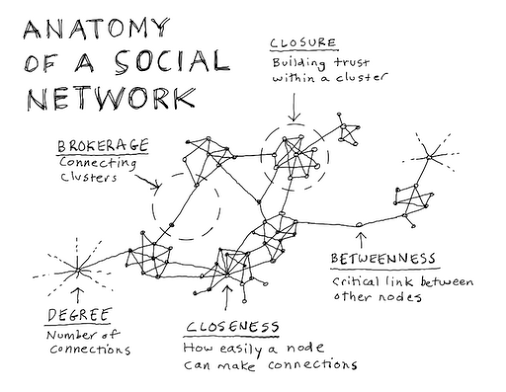
Think about who you follow and who follows you on social media. They are mostly likely your friends, family, co-workers, classmates, high school friends and maybe a celebrity or brand or two. We tend to look at the number and people, and that’s about it. But mass communication and social media scholars view those relationships differently. They see them as networks of nodes connect to each other by lines and bridges. While these networks show us how interconnected we are, they can also show us how cut off from the rest of the world we may be. Networks can also show us who the key influencers are that connect different networks through bridges. These bridges are important because they could be the key to disseminating information to homogenous groups such as hyper-polarized political activists.
Numerous researchers have studied the way networks influence and tilt conversations online, particularly on Twitter. During the 2012 U.S. presidential election campaign, rumor spreaders circulated false information in hyper-polarized follower networks and formed even stronger partisan groups. These groups typically revolved around a core of highly-motivated partisan individuals and political elites rather than just ordinary citizens. The use of retweets boosted the influential rumor spreaders and empowered them to continue spreading negative and false messaging about Obama or Romney, depending on in which camp they resided. Their connections sometimes allowed them to reach opposing political groups, adding more fuel to the fire of political debate and partisanship.
Similarly, Twitter conversations surrounding the European Union’s “Right to Be Forgotten” were dominated by elite experts and news outlets. Ordinary citizens, which the new policy was mostly concerned with, were not engaged with the hashtag at all, unless they were just lurking. The connections the elite experts had gave them the ability to bridge networks among different communities and share their expertise and opinions on the topic. While this kind of insight could be helpful for ordinary citizens to understand the complexities regarding the RTBF, it also could have deterred them from contributing since it appeared that only experts talked about it. Yang et. al. (2017) put it well when they said that the Twittersphere is:
“...a dynamic space consisting of a multitude of small clusters that function largely independently and in a decentralized fashion."
While Twitter has over 145 million daily active users, many trending conversations are controlled by a few.
The issue with a few dominating the top conversations on Twitter is that the Internet was optimistically supposed to be a place where all voices were equally heard. Depending on your network, this may very well be the case if the people you follow only follow each other, thus creating an “echo chamber.” Of course as we’ve talked about in the past, echo chambers never really become reality. Instead, users who have strategic connections outside of their immediate networks bridge groups together and share information faster and wider than many others. They become the dominate leaders in trending conversations, whether for good (to share their expert insight) or for bad (to share false rumors about opposing candidates). Is this something we as a society need to fix? Are we missing out on important insight on public opinion if only a few are dominating the conversation?


Comments